

CO-LAB
OPEN INFRASTRUCTURE FOR REMADE TEXTILE SYSTEMS
Between resale and recycling, there are very few structures that allow textiles to stay in use — especially when materials are irregular, mixed, or already worn. As a result, millions of tonnes of surplus, returns, and production offcuts lose value far too early, even when they consist of high-quality natural fibres.
Today, this gap is mostly addressed through two extremes:
small-scale, manual upcycling on one side, and recycling technologies on the other.
What is largely missing are shared, repeatable infrastructures that enable remade production beyond individual craftsmanship — while preserving material quality and meeting regulatory, certification, and production requirements.
CO-LAB was initiated to address exactly this gap.
WHAT CO-LAB IS
Co-Lab is an emerging social enterprise and collaborative infrastructure for remade textiles.
Our focus is on keeping materials in use before recycling, by developing design-led systems that allow products to be repaired, adapted, and remade across multiple cycles.
We work with the understanding that fashion is not a linear supply chain, but a system connecting people, materials, labour, and time.
Our approach is Nature First and grounded in emotional longevity.
Design is our starting point — not as styling, but as a tool for structural transformation.
WHY WE START SMALL — AND WITH ONE PRODUCT
The challenge CO-LAB addresses is complex.
We have repeatedly attempted to place remade production using surplus and post-consumer textiles — and found that suitable production partners in Europe were simply not available. Existing infrastructures are not designed to handle irregular material streams, nor to integrate remade processes in a way that is certifiable and scalable.
For this reason, Co-Lab does not begin with large-scale production.
Instead, we deliberately start with one understandable, everyday product that allows us to develop and test infrastructure step by step.
FIRST PILOT: THE HOTEL SLIPPER PROJECT
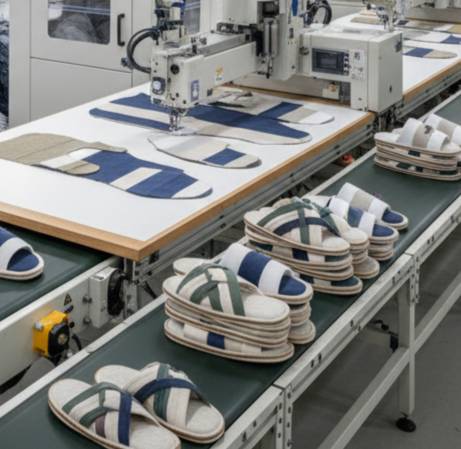
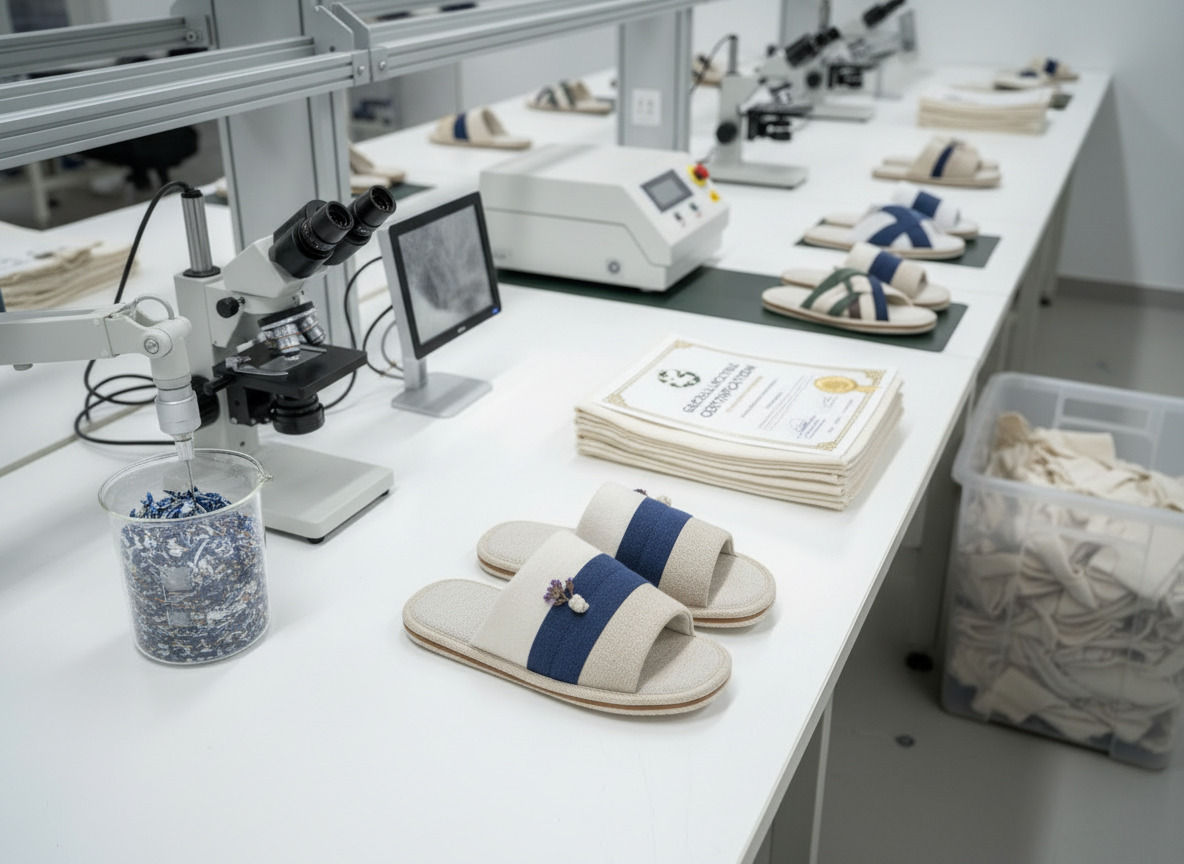
The first Co-Lab pilot focuses on hotel slippers made from remade natural-fibre textiles.
This product was chosen deliberately:
Hotels are actively seeking more sustainable alternatives
Guests increasingly perceive conventional slippers as unnecessary waste
Slippers require relatively small material pieces
They allow for real-life wear and material behaviour testing
They provide a realistic pathway toward certification and B2B adoption
The slipper is not the innovation.
The infrastructure behind it is.
Through this pilot, we test how remade production can work under real conditions — from material intake to cutting logic, construction, durability testing, and documentation.
HOW WE WORK
Co-Lab develops tools and processes that work with real material realities, not idealised ones.
We work with:
surplus, returns, and deadstock
post-consumer natural-fibre textiles
irregular material streams that resist standardisation
Our methods aim to:
support emotional durability
integrate remade potential already at the design stage (Design for Seven Seasons)
connect cultural, social, and technical dimensions of circularity
We operate at the intersection of design, technology, and collaboration, developing systems that are functional, culturally embedded, and adaptable over time.
TOOLS & STRUCTURES IN DEVELOPMENT
Together with partners, Co-Lab is developing three connected building blocks:
RECONNECTED software
A design-led system that documents material flows and supports the design and planning of remade products — linking digital planning with manual or industrial production.
Modular process architecture
A flexible foundation that allows remade workflows to be integrated into existing production environments and local manufacturing contexts.
Open, collaborative standards
To enable cooperation between resale, processing, and recycling actors — instead of isolated solutions.
WHY NOW
New regulatory frameworks such as Extended Producer Responsibility (EPR) and the EU Strategy for Sustainable Textiles require companies to rethink how textile surplus and waste are handled.
Co-Lab positions itself not as a product provider, but as a partner and infrastructure builder, working collaboratively with industry, craft, research, and public actors.
Co-Lab is currently supported through the KU-Match program (Kreatives Unternehmertum).
AN OPEN INVITATION
Co-Lab is intentionally open and evolving.
We believe that remade textile systems cannot be built by one actor alone.
Research partners, manufacturers, designers, institutions, and public bodies are invited to contribute, test, and co-develop this infrastructure.