
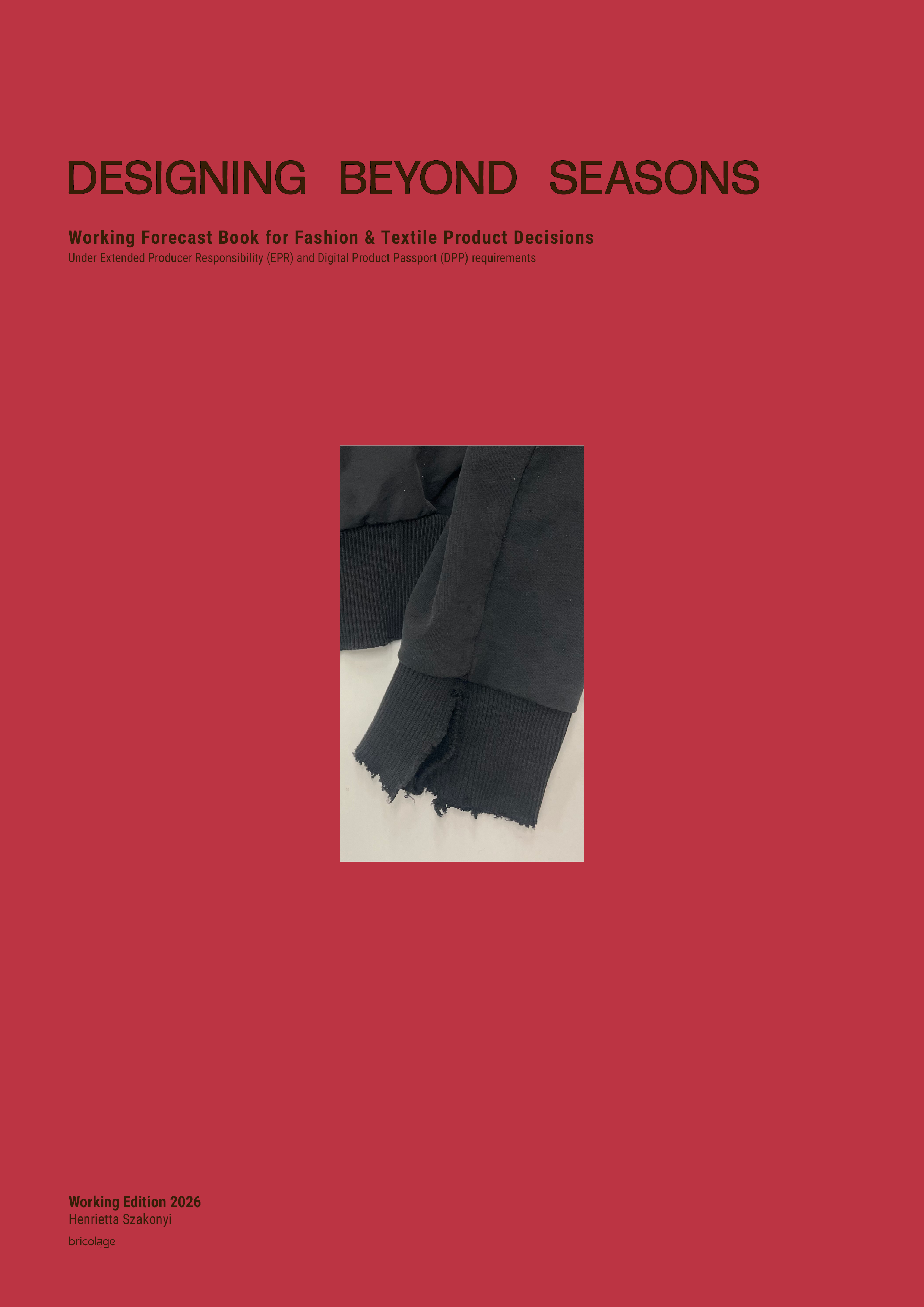
Designing Beyond Seasons
Working Forecast Book for Textile & Fashion Product Decisions
A working book for product decisions under Extended Producer Responsibility (EPR) and the Digital Product Passport (DPP) — grounded in material behaviour, use, repair thresholds, and remade feasibility.
Working Edition 2026
Designing Beyond Seasons is a working tool for teams making material and construction decisions under increasing regulatory and economic pressure.
It introduces a practical language for durability, care, repair, and remade — helping teams understand how early product decisions shape repairability, residual value, and long-term cost exposure.
The framework connects material behaviour, product design, and emerging regulatory requirements, supporting clearer decisions before systems and supply chains become fixed.
Used in advisory work, workshops, and applied feasibility pilots.
View the preview excerpt or request a working copy for teams.
What the Working Forecast Book Explores
Editorial
Introduces the shift from downstream sustainability reporting to upstream product responsibility. With Extended Producer Responsibility (EPR) and Digital Product Passports (DPP), early material and construction decisions increasingly determine repairability, residual value, and long-term cost exposure.
From Product to Relationship System
Reframes fashion as a relationship system across materials, bodies, labour and time. Instead of short-term products, garments are considered within longer relationships between use, care, repair and material continuity.
Working with Teams
Explains the advisory method of “reading the product”. Garments are analysed through use patterns, repair history, construction logic and material limits to identify decision thresholds before larger investments or pilots.
Reading Use
Positions wear and ageing as operational design information. Abrasion, stress zones and repair marks reveal how materials and construction behave over time and inform early product decisions.
Emotional Durability
Explores how material coherence and ageing influence attachment and time in use. Emotional durability becomes a behavioural factor that stabilises product lifespan.
From Observation to Decision
Translates observations into practical decision fields: repair thresholds, construction logic, material behaviour, economic feasibility and Digital Product Passport documentation.
Nature-First Design
Introduces Nature-First Design as a decision framework grounded in material behaviour and ecological limits. Wear, patina and ageing become signals rather than defects.
Designing Beyond Delivery Cycles
Examines how delivery cycles concentrate value at launch but often destroy it shortly after. The chapter explores how design decisions can manage surplus, redistribution, repair and remade.
Seven Seasons Framework
Introduces Seven Seasons as a decision architecture that allows garments to move through phases of use, care, repair, remade and transformation across time rather than across seasonal delivery moments.
Case Study — Regulatory Readiness
A product review comparing repair, disassembly and recycling pathways under EPR and Digital Product Passport conditions. Outputs include decision thresholds and minimal documentation datasets.
Case Study — Remade Feasibility
Explores whether existing garments or surplus stock can realistically enter remade production. Introduces feasibility classifications and pilot preparation metrics.
Final — Working Edition
Positions the Working Forecast Book as a working tool for advisory work, workshops and product decision processes under increasing regulatory pressure.
How the Workbook Is Used
The Working Forecast Book is not only a publication.
It functions as a practical working tool used in advisory sessions, workshops, and feasibility assessments.
The approach combines observation, design analysis, and regulatory context to help teams clarify early product decisions.
Typical tools used in the process include:
Reading use: analysing wear patterns, stress zones, and repair histories
Repair thresholds: identifying when repair remains meaningful and when other pathways become more viable
Construction logic analysis: evaluating how seams, components, and materials influence adaptability
Material behaviour assessment: understanding how fibres and textiles change through use and care
Remade feasibility evaluation: determining whether existing garments or surplus stock can enter remade production
Documentation mapping: identifying what information is realistically required for Digital Product Passports
Typical Outcomes
Workshops and advisory sessions often result in:
identification of critical wear zones and material behaviour
repair vs. disassembly decision thresholds
construction adjustments for future collections
remade feasibility assessments for existing products or surplus stock
initial Digital Product Passport documentation logic
internal decision memos for product and sustainability teams
The goal is not immediate transformation, but clearer early-stage decisions before systems and supply chains become fixed.
Economic Perspective
Product decisions in fashion and textiles increasingly carry economic consequences over time.
Under Extended Producer Responsibility (EPR) schemes and emerging Ecodesign requirements, companies become responsible not only for production but also for the long-term handling of products after sale.
Material choice, construction logic, and repairability influence:
future waste management costs
repair and service feasibility
remade potential
regulatory compliance effort
long-term material value retention
Many of these outcomes are determined early in the design process.
The Working Forecast Book therefore examines how product design decisions influence not only sustainability outcomes, but also cost exposure, operational feasibility, and residual material value.
Rather than treating circularity as a downstream problem, the approach focuses on upstream product decisions that shape long-term economic outcomes.